
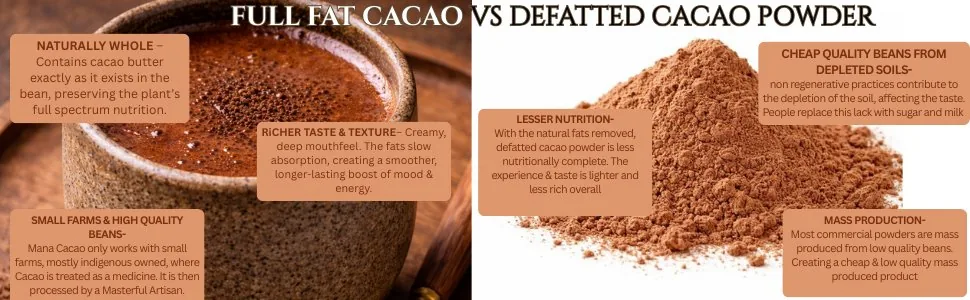
Ceremonial cacao, cacao powder and cocoa powder all start as the same bean. The difference is what happens after harvest, and above all, whether the natural fat stays in.
The short answer
Ceremonial cacao is the whole ground bean with its cacao butter intact. Cacao powder and cocoa powder have both had most of that butter pressed out; cocoa is usually processed at higher heat and is often alkalized to make it milder and darker.
| Ceremonial cacao | Cacao powder | Cocoa powder | |
|---|---|---|---|
| Cacao butter | All of it stays in | Mostly pressed out | Mostly pressed out |
| Processing | Gentle, small batch, whole bean | Lower heat, defatted | Higher heat, often alkalized (“Dutch-processed”) |
| Ingredients | 100% cacao | 100% cacao | Cocoa, sometimes with alkali; mixes add sugar and milk powder |
| Taste & texture | Rich, creamy, deep, slightly bitter | Dry, sharp, lighter | Mild, flat, usually needs sugar |
| Best for | Drinking on its own as a ritual drink | Smoothies, raw desserts | Baking, hot chocolate mixes |
Cacao vs. cocoa: is it just spelling?
Partly. “Cacao” is the original word, from the Mesoamerican languages; “cocoa” is the English version that took over as chocolate became an industrial product. Today the words are used inconsistently, but as a rule of thumb, “cocoa” on a label means a more heavily processed, defatted powder, and “cacao” suggests something less processed. Neither word guarantees the fat is still in. That's why the ingredient list and nutrition label matter more than the name.
Why the fat matters
Cacao butter makes up roughly half of the bean. Keeping it changes almost everything about the drink:
- Body and mouthfeel. Full-fat cacao makes a creamy, satisfying cup even with water. Defatted powder tastes thin unless you add milk and sugar.
- Flavor. Many of cacao's aromatic compounds are carried in the fat, so whole cacao tastes rounder and more complex.
- How it feels. Fat slows absorption, which is part of why people describe the lift from ceremonial cacao as smooth and steady rather than sharp.
- Wholeness. Nothing is removed, so you're drinking the bean as nature made it.
What “Dutch-processed” means
Dutch-processed (alkalized) cocoa has been treated with an alkaline solution to neutralize its natural acidity. It turns the powder darker and the flavor milder, which is useful in some baking. The trade-off is that alkalizing also reduces some of the flavanols naturally found in cacao. Ceremonial cacao is never alkalized.
Can you swap one for another?
For drinking, ceremonial cacao is the one built for the job. In baking, recipes are written for defatted cocoa, so swapping in full-fat cacao adds extra fat and can change the texture; reduce the butter or oil a little if you try it. In smoothies, any of them works, but whole cacao gives the creamiest result.
Learn more about what makes cacao ceremonial or see how to prepare a cup.